- Vendoroo Newsletter
- Posts
- What Happens To Your Best Maintenance Person After AI?
What Happens To Your Best Maintenance Person After AI?
The 250-door benchmark is officially obsolete. Here is the New Collar math.

Pablo Gonzalez
May 13, 2026
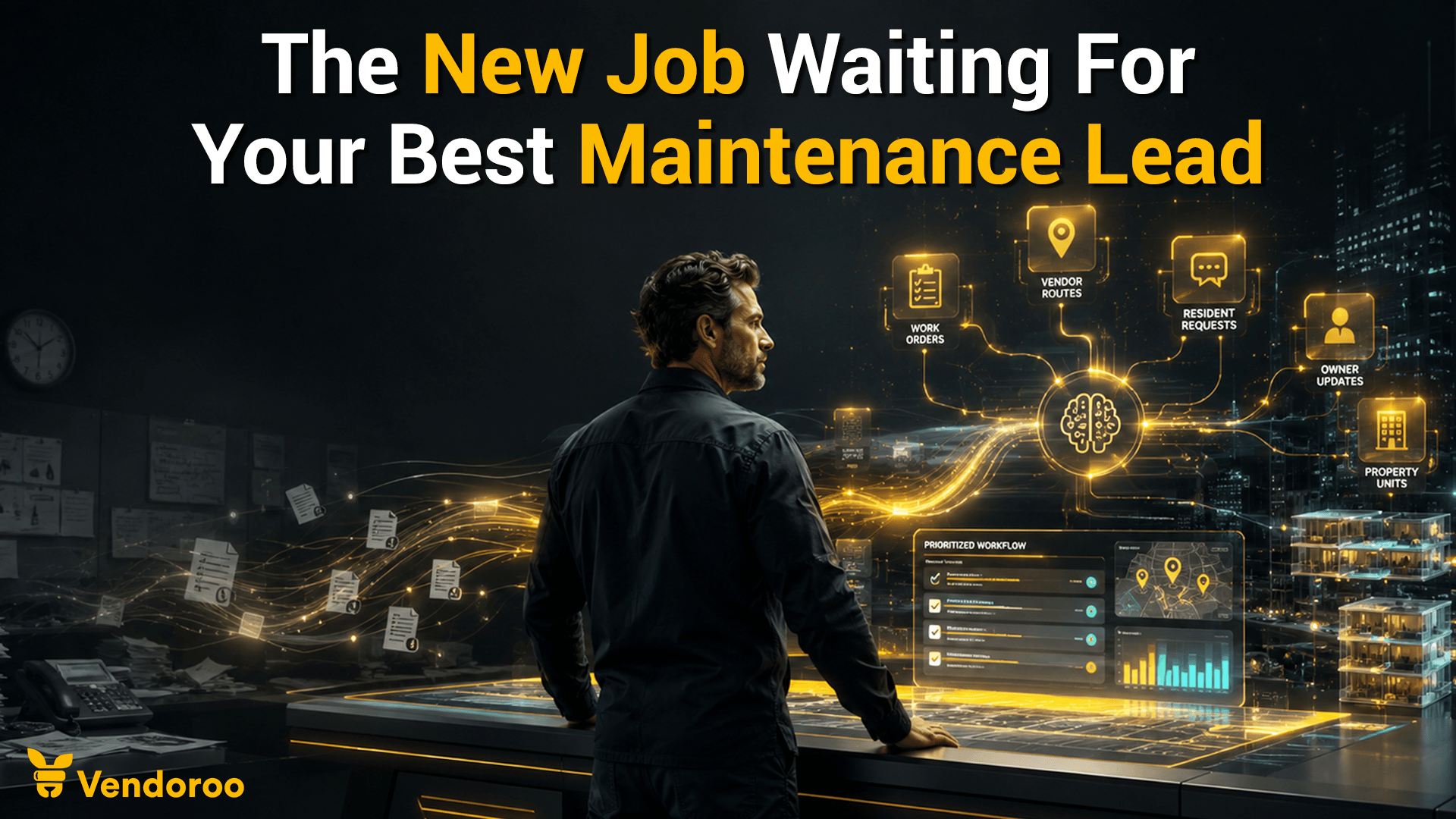
The New Job Waiting For Your Best Maintenance Lead
🎧 Listen to the Audio Version Below
The industry says one maintenance coordinator can handle 250 doors.
At a recent dinner in DFW, David Normand, our Chief PM, broke that frame-
In an AI-native environment, that benchmark is OBSOLETE. The new target is 1,500 doors per coordinator. This isn't about cost-cutting. It’s the birth of the "New Collar" maintenance worker.
As I listened to David, I kept thinking back to a conversation I had a few months ago with Bill Davy, the Maintenance Manager and AI Chief at Happy Homes, who lived this transformation before the industry even had a name for it.

THE HUMAN CHOKE POINT
Bill Davy didn’t set out to become what people now call an AI Team Lead. He was just trying to build a maintenance operation that could grow and keep a high standard of service.
Before property management, he worked at Lowes. He built his expertise helping experienced contractors and DIY homeowners solve problems. As he grew his department, he slowly formed a mental model of how to teach his team to help others help themselves.
That's a familiar feeling for all great team leaders.
But it also becomes a choke point for growth.
I’ve seen this pattern over and over. When the system lives inside one person’s mental framework, growth stops feeling exciting and starts feeling dangerous. And if you can't find more people like them, your only option is to hire button-pushers who lack the judgment to move the needle.
WHEN THE ROLE STARTS TO SHIFT
The goal wasn’t to automate Bill out of relevance, but to replicate his judgment.
That idea was unsettling at first. The industry has been promised tools like this for years, and most of them failed to deliver. Bill felt the tension, but that normally shows up whenever roles evolve faster than expectations.
But you know what? He still leaned into that shift instead of fighting it.
Now, his maintenance department operates at 97% automation. And he’s talked openly about what that early phase looked like. The messy, uncomfortable stretch where “letting go” wasn’t a mindset shift. It was a daily practice.
But the part that matters most for this moment isn’t the implementation story.
It’s what happened to the job.
Because once repetitive coordination started moving through the system, Bill’s role didn’t disappear. It changed.
It moved toward judgment. Toward standards. Toward teaching the system how a great maintenance operator thinks.
This is the part most people misunderstand about AI-first operations.
The biggest value isn’t “doing the same work faster.” It’s changing the type of work humans spend their energy doing.
The old maintenance coordinator role rewarded responsiveness.
The new one rewards judgment.
You’re no longer the human router sitting between residents, vendors, owners, and your PMS. You become the person shaping how the machine operates. You train standards. You identify failure points. You improve workflows. You catch edge cases before they become owner churn. You build operational intelligence into the system itself.
That’s a completely different job.
And honestly? A much more valuable one.

And this is the exact reason David Normand and I are hosting the AI-first maintenance workflow webinar tomorrow.
Because a lot of PM companies are signing up for AI, but their teams are still doing the same things they did yesterday. That’s not because the teams are bad. It’s because nobody has shown the frontline staff what their new “Day One” actually looks like.
So we’re going to show it.
David and I are breaking down what we’ve learned after 500+ agentic AI deployments, including what maintenance coordinators no longer need to do, how parts of the role change, which new abilities your team now has time to build, and why operators are moving to this workflow to stop team churn.
No Level 20 tech-talk.
Just the ground-level workflow.

THE ROAD TO 1,500 DOORS
This is how the 1,500-door benchmark stops sounding impossible.
Not because you found superhuman coordinators.
Because the repetitive coordination work gets absorbed by the system, and your best operators finally get to focus on judgment, relationships, and asset performance.
This isn’t workforce reduction. It’s role evolution.
And it’s the only way to grow without burning out the very people who built your company. The companies embracing this early are already scaling differently- moving faster without flattening nuance, building systems that outlast their own presence, and protecting the human side of maintenance along the way.
If you want to see what this looks like in the actual maintenance workflow, join us tomorrow, May 14th at 3 PM ET.
David Normand and I are going to walk through the AI-first maintenance coordination workflow, what changes for your maintenance coordinators, and how to make sure AI actually sticks after implementation.
Bring your hardest questions.
Seriously.
That’s the point of this one.

Pablo Gonzalez
Chief Evangelist at Vendoroo